Apps & Services
Samsung Is Finally Taking Bixby Seriously, and the New Version Shows Why

For years, Bixby was the assistant Galaxy users tolerated rather than used. It came pre-installed, resisted being removed, and rarely did anything better than just opening Google. Samsung kept updating it in small ways, but nothing stuck. The gap between what Bixby promised and what it actually delivered became something of a running joke among Android enthusiasts.
With One UI 8.5, Samsung is rolling out a Beta version of a rebuilt Bixby, one that moves away from the rigid, command-based structure that made the old version frustrating and toward something closer to a genuine conversational agent. The difference, at least in theory, is significant.
The Old Problem With Bixby Was Never Really About Voice
Most people assumed Bixby underperformed because its voice recognition was weak. The real issue ran deeper. The assistant required users to phrase requests in specific ways, remember exact setting names, and essentially speak the phone’s language rather than their own. That friction made it faster to just tap through menus manually.
The new version flips that logic. Users can describe what they want in plain, natural terms, and Bixby interprets the intent behind the request rather than parsing it for keywords. If you say you do not want the screen turning off while you are actively looking at it, the assistant activates the relevant setting without you needing to know it exists or where it lives inside Android settings.
That is a small example, but it points to something more meaningful: Samsung is trying to make Bixby useful to people who never bothered to learn how their phone actually works under the hood.
Context Matters More Than Commands Now
What stands out in this update is the shift toward contextual problem-solving. The redesigned Bixby does not just respond to requests. It can read the current state of your settings, understand the broader situation, and suggest fixes that match what you are actually experiencing.
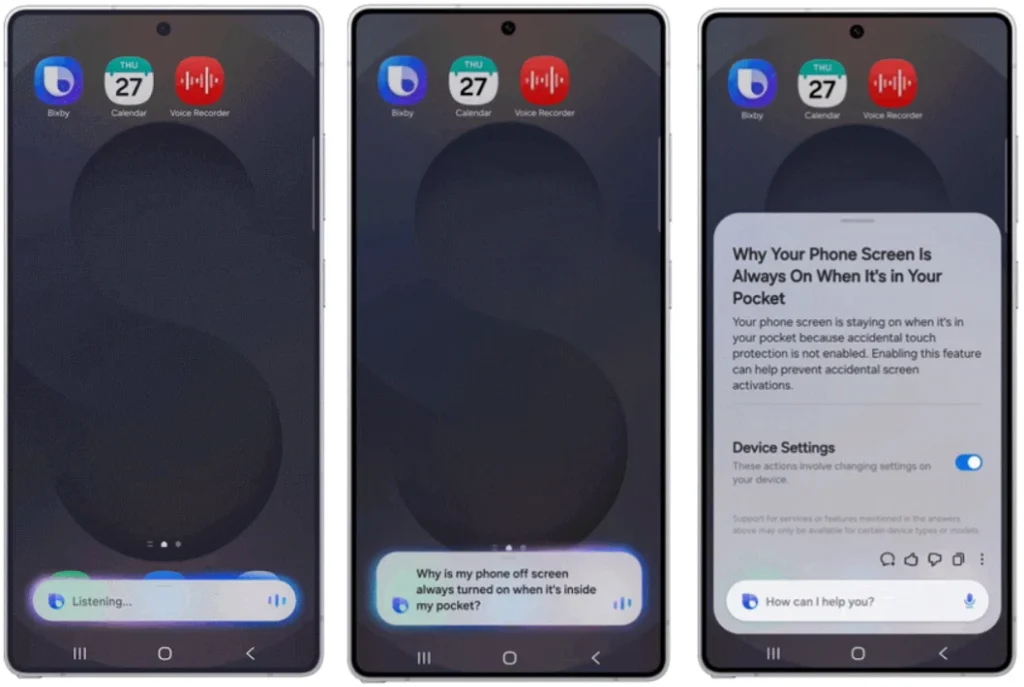
Ask why your screen keeps turning on inside your pocket, and instead of serving up a generic search result, Bixby identifies the likely culprit, something like accidental touch protection being disabled, and offers to switch it on. That kind of response requires the assistant to connect the symptom to the cause without being explicitly told the connection.
Whether this works consistently in real-world use is still an open question. Beta programs exist precisely because intent recognition at scale is hard to get right. But the approach itself is more sophisticated than anything Samsung has attempted with Bixby before.
Web Search Built Into the Assistant, Not Around It
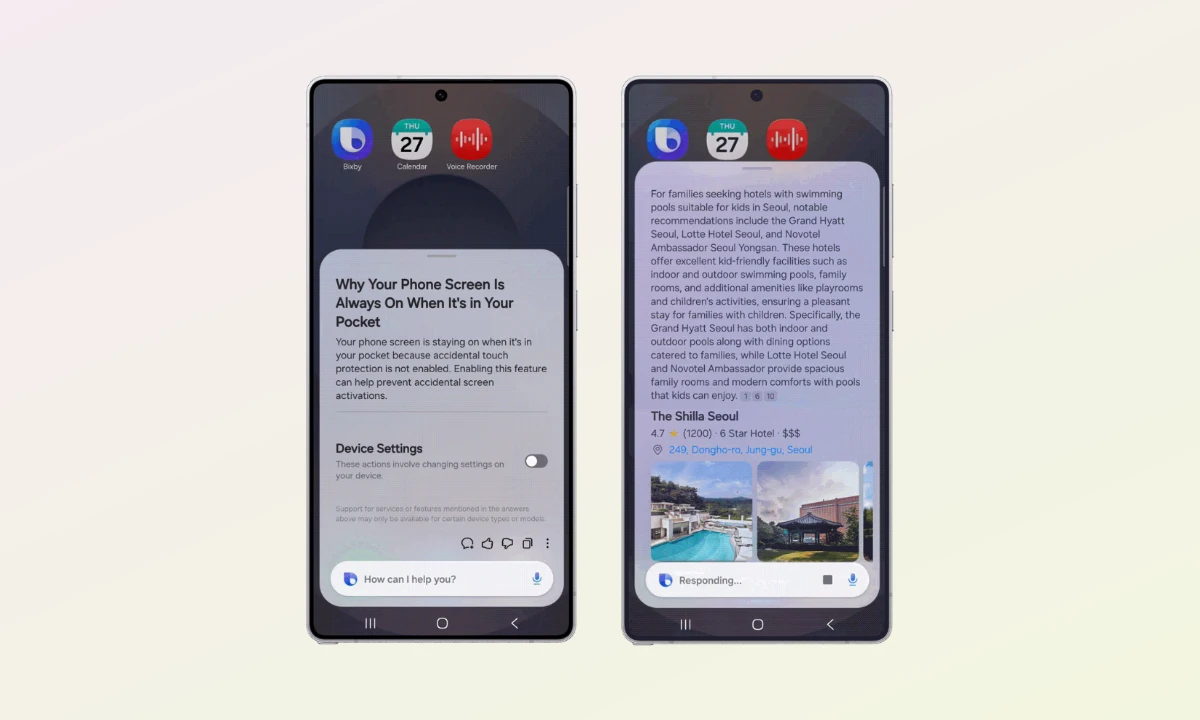
The other meaningful addition is real-time web search displayed directly inside the Bixby interface. Previously, asking Bixby something that required live information meant getting handed off to a browser, which broke the experience entirely. Now the results appear within the assistant itself.
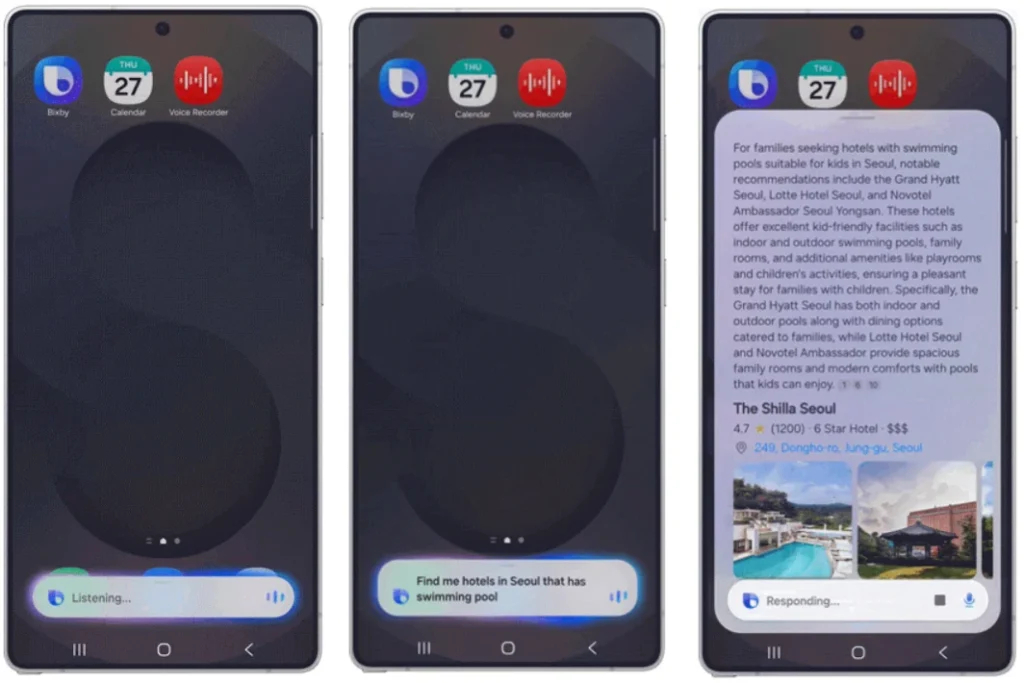
The practical implication is that Bixby starts functioning as a single environment for getting things done, rather than a launcher that connects you to other apps. Ask it to find family-friendly hotels with pools in Seoul, and it returns results you can browse without leaving the conversation.
This matters more than it might seem. One of the reasons dedicated AI assistants have gained traction is that they keep users inside a contained, coherent experience. Samsung is trying to replicate that on the device level.
A Necessary Move, Not a Surprising One
Samsung’s COO of the Mobile eXperience division, Won-Joon Choi, framed this as making AI more natural and accessible by embedding it directly into how people use their Galaxy devices. That language is careful and deliberate. Samsung is not positioning this as a competitor to ChatGPT or Google Gemini. It is positioning Bixby as the layer that sits between the user and the phone itself.
That is actually a smarter angle than trying to out-answer every AI chatbot on the market. If Bixby can reliably handle the device-specific, system-level tasks that other assistants fumble with because they lack deep hardware integration, it occupies a useful and distinct space.
The Beta is currently live in Germany, India, South Korea, Poland, the United States, and the United Kingdom. Samsung has indicated broader availability is coming but has not committed to a timeline for other markets.
Bixby has been given second chances before, and they did not amount to much. This update is structurally different from those incremental refreshes, but the proof will come from how well the intent recognition holds up after weeks of varied, unpredictable real-world use. If the execution matches the design, Samsung might finally have an assistant worth keeping turned on.